A slight deterioration in air quality is expected by 2025, with exceedances of current regulations still being observed.
In 2025, nitrogen dioxide (NO2) concentrations are expected to increase slightly, both near major roads and in areas away from traffic. For fine particulate matter (PM2.5), the observed increase is mainly due to a harsher winter than in 2024, which led to increased heating use and limited the dispersion of pollutants. This trend, primarily linked to less favorable weather, underscores the need to continue the progress made in recent years.
In the long term, a structural improvement in air quality, with the exception of ozone.
Despite this slight deterioration, the underlying trend remains positive. Over the past twenty years, nitrogen dioxide concentrations have halved in the Île-de-France region, and fine particulate matter concentrations have decreased by approximately 60%. These results reflect the tangible effects of public policies implemented at various levels.
However, some local situations remain worrying. Approximately 1,500 people in the Île-de-France region will still be exposed in 2025 to pollution levels exceeding current regulatory limits.
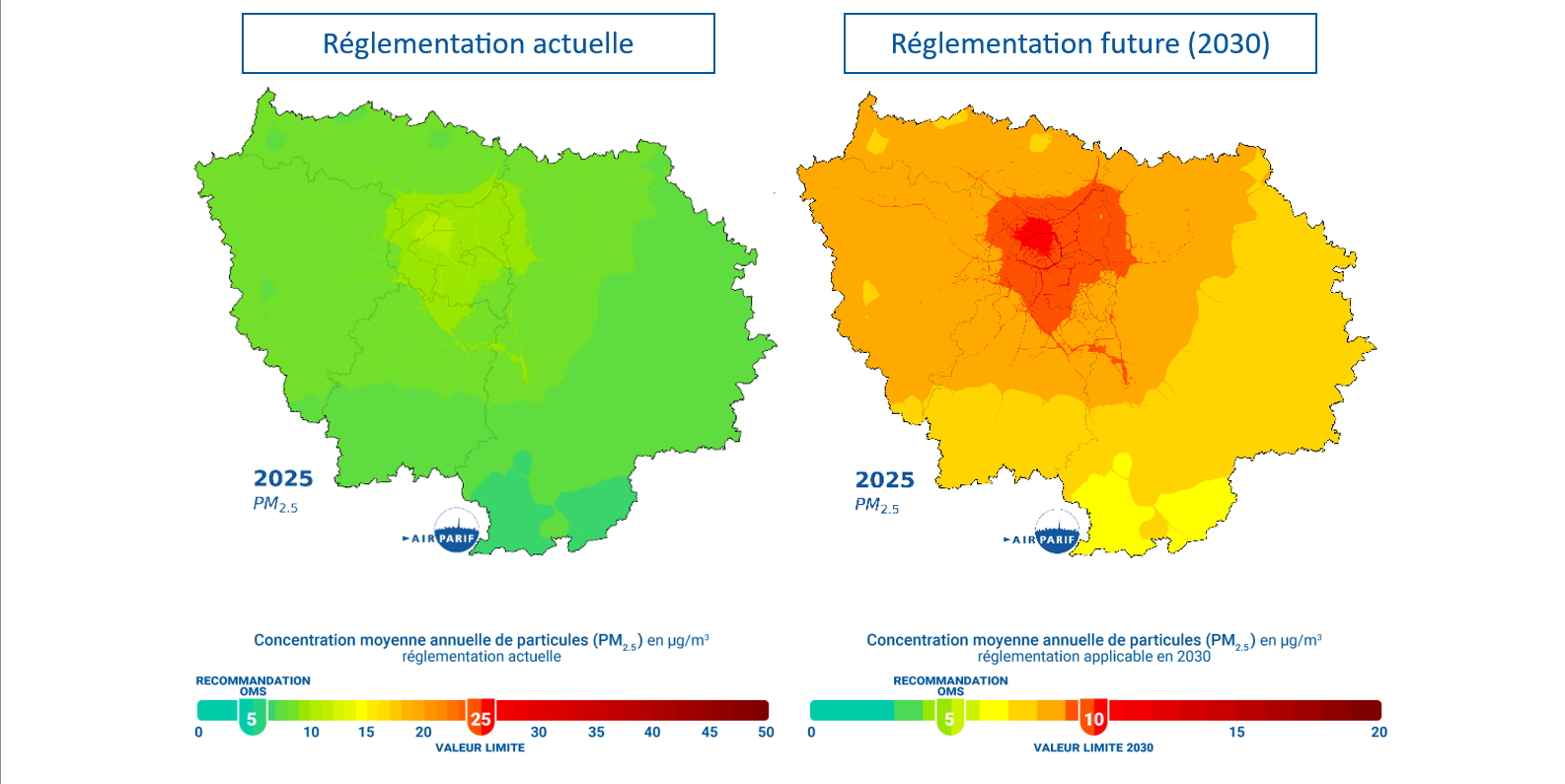
A quarter of people in the Île-de-France region are still at risk of exceeding future regulatory thresholds: a major public health issue
Beyond current regulations, the main issue now concerns future European standards that will come into force from 2030. These new limit values will be stricter in order to better take into account the health effects of air pollution, now documented at lower exposure levels than before.
In this context, the 2025 assessment shows that approximately one quarter of the people of the Île-de-France region currently live in areas where pollution levels would already exceed the future limit values of 2030. This proportion is up compared to 2024, when it concerned approximately 20% of the regional population.
Air pollution remains a major public health issue. In the Île-de-France region, it is responsible for approximately 8,000 premature deaths each year and contributes to the development or worsening of numerous chronic diseases, particularly respiratory and cardiovascular diseases.
Ozone also presents a particular challenge. Unlike other air pollutants, its levels do not decrease over the long term. A pollutant harmful to health and a greenhouse gas, ozone illustrates the increasing complexity of the links between air quality and climate change.
The results of the 2025 assessment thus serve as a reminder that the improvements observed over the past few decades are not permanent. They are the result of long-term public policies and changes in practices that have proven their effectiveness.